
ФАКУЛЬТЕТ КОМП’ЮТЕРНИХ НАУК ТА ІНЖЕНЕРІЇ

Address: room 224, mechanical building, Nab. Peremohy, 40, Dnipro, 49094
e-mail: [email protected]
tel.: (093) 433-02-07
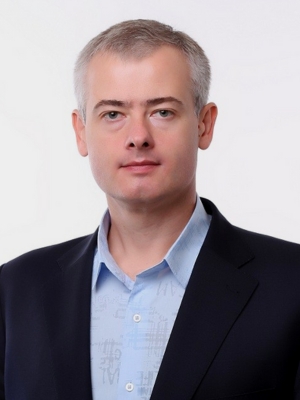 Ihor Leonidovich Levchuk
Candidate of Technical Sciences, Associate Professor of the Department of Computer-Integrated Technologies and Automation
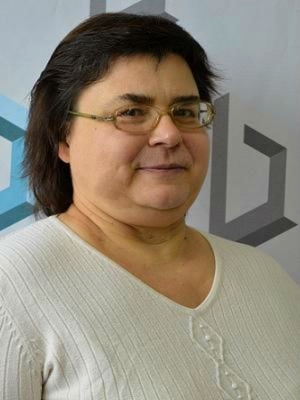 Serbulova Inna Valeriivna
Senior Lecturer, Department of Information Systems
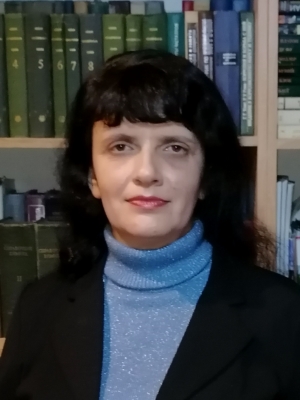
Bannyk Nataliya Grigorivna
Candidate of Technical Sciences, Associate Professor of the Department of Innovative Engineering

Hnatko Olena Mykolaivna
Senior Lecturer, Department of Materials Science
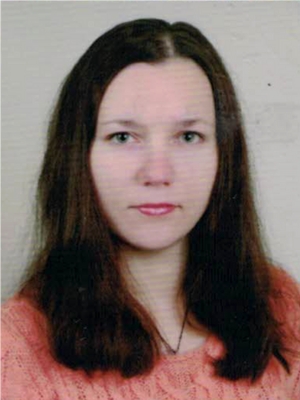 Olha Volodymyrivna Khrystenko
 Kateryna Valentinivna Galiba
The specialties in which specialists are trained at the Faculty of Computer Science and Engineering of the National Research Institute of the State Chemical Technical University of Ukraine are very relevant and necessary for today. The development of information technologies and their use in chemical production requires specialists who would combine knowledge in the field of chemical and computer technology, and would create systems for controlling technological processes.
The faculty trains specialists for Bachelor’s and Master’s degrees in the following specialties and educational programs:
- F2 (121) Software Engineering
- F3 (122) Computer Science
- F7 (123) Computer Engineering
More details...
The specialty 121 Software Engineering is focused on training specialists who are involved in the development, testing, debugging and modification of software. Software engineering specialists are called upon to implement all stages of the technology of creating software products (PP) and software (PL) during their life cycle: determining and analyzing requirements for PP and software, designing the architecture of the software system, detailed design, construction, integration of software tools, their testing, installation, support, maintenance and contribute to the timely replacement/decommissioning of software tools.
The specialty 122 Computer Science (the direction of training “Computer Science”) trains specialists in the field of computer science, programming, information systems and technologies. At the Department of Information Systems of our faculty, future specialists in the field of information systems study the following main sections of computer science: algorithms and data structures, programming languages, computer architecture, operating systems and computer networks, software development, databases and information search systems, artificial intelligence and robotics, computer graphics, human-computer interaction, etc. Traditionally, the direction of “Computer Science” has a closer connection with mathematics. The most important goal of training computer science specialists at the Department of Information Systems is to clearly understand the relationships that exist between application programs and computer systems, because becoming a specialist in modern information technologies is possible only with a comprehensive study of all components of computer science.
Specialty 123 Computer Engineering. Computer engineers design, develop and maintain smartphones, computers, computer networks, programmable robots, scanners, plastic cards, artificial intelligence systems and their software. They provide machines, devices and equipment with embedded computer systems for controlling them, in particular using mobile devices. Our computer engineers receive fundamental knowledge and practical skills in the field of complex calculations, computer technology and software. They receive the most versatile knowledge in the field of information technology, becoming IT professionals. Computer engineers are highly sought-after and highly paid IT specialists in all developed countries. Our specialists acquire the most up-to-date knowledge and practical skills in computer engineering among domestic universities. We have brought our curricula in line with the best European universities, which allows our students and graduates to continue their studies at prestigious universities in developed countries of the world. Computer engineers largely determine the progress in the life of society and each person.
- G8 (132) Materials Science
- G9 (131) Applied Mechanics
- G11 (133) Industrial Mechanical Engineering
More details...
Specialty 131 Applied Mechanics (educational program Mechanical Engineering Technologies) – students receive modern knowledge and skills for designing modern technological processes for manufacturing parts, assembling machines, studying technological equipment and tools necessary for ensuring product quality at mechanical engineering enterprises and other industries. During their studies, students study automated production systems, robotic complexes, numerically controlled machine tools, learn computer-aided design, construction of machines and equipment, and learn how to manage an enterprise.
Specialty 133 Industrial Mechanical Engineering is the most versatile. The scope of activity of a mechanical engineer includes enterprises of almost all branches of industry, both food (production of ice cream, sweets, coffee, milk, meat processing, etc.) and chemical (production of building materials, glass, ceramics, fuel, polymer products, mineral fertilizers, etc.), because the object of activity of a mechanical engineer is technical equipment and production processes for processing raw materials and semi-finished products into marketable products.
A mechanical engineer at an enterprise organizes the production, installation and commissioning, operation, maintenance and repair of technological equipment, in a design office he is engaged in the design, construction of machines, selects corrosion-resistant structural materials for equipment and develops methods of protection against corrosion and wear, studies the technological processes that occur in equipment to increase the efficiency of its operation, and implements innovative and energy-efficient solutions.
The specialties 131 Applied Mechanics and 133 Industrial Mechanical Engineering are particularly relevant today due to the development of small enterprises, where one specialist controls the technology, equipment, and economic aspects of production.
After graduation, a student can choose a huge range of enterprises and industries as a place of work:
- oil processing;
- chemical industry (production of chemicals, polymer products, mineral fertilizers, paint and varnish plants, etc.)
- building materials (production of refractories, ceramic materials, glass enamel coatings, brick and cement plants, etc.)
- mechanical engineering for various purposes (chemical and heavy engineering, aggregate plants, refrigeration plants, experimental repair and mechanical institutes, etc.)
- food industry (confectionery factories, dairies, bakeries, breweries and distilleries, meat processing plants, etc.)
- processing industries (meat and fish processing, grain and sugar processing beet, oil extraction plants, etc.)
- research institutes, pre-higher and higher education institutions.
Specialty 132 Materials Science is one of the promising specialties, for which the university recently received a license to conduct educational activities. The educational program Jewelry, Dental and Orthopedic Materials Science is a unique educational program, which for the first time in Ukraine has initiated the training of materials science specialists with a bachelor’s degree in the fields of jewelry, dentistry and orthopedics. In addition to traditional training in general materials science, which will allow them to find employment at machine-building, construction or metallurgical enterprises, students will also acquire knowledge and skills in new specializations in the medical and jewelry fields. Such training of broad-profile materials scientists with an emphasis on improving the quality of life, health and well-being of a person will contribute to their demand not only in our country with a huge number of jewelry and orthopedic enterprises and dental companies, but also abroad. Possible employment of graduates in the positions of research engineer, process engineer, quality control engineer, production manager, laboratory manager, shop (shift) manager, deputy director for quality.
- G3 (141) Electrical Power Engineering, Electrical Engineering and Electromechanics
- G4 (144) Thermal Power Engineering
More details...
Energy plays a crucial role in the functioning and development of the state. Electricity production in Ukraine is currently provided mainly by nuclear power plants (NPPs), thermal power plants (TPPs) and hydroelectric power plants (HPPs, PSPs). Wind, solar power plants, as well as power plants running on biofuels are also increasingly used. That is why the educational programs Electrical Power Engineering, Electrical Engineering and Electromechanics and Thermal Power Engineering are critically relevant in our time.
- G6 (175) Information and measuring technologies
- G7 (174) Automation, computer-integrated technologies and robotics
More details...
SEI USUCT is the first educational institution in our region to begin training specialists in the educational program Metrology and Information and Measurement Technology (bachelor) and specialty 175 Information and Measurement Technology. With twelve years of experience in training specialists, qualified teachers and the appropriate material and technical base, we guarantee high-quality training of specialists in this field. Features of the profession. Measuring devices are used in all areas of life: meters, scales, radars, medical diagnostic equipment, etc. The safety and health of people, product quality and economic indicators depend on the accuracy of measurements. Metrologist tasks: verification (verification) of the operation of devices in accordance with the requirements of standards; participation in the development and implementation of standards; work with measuring equipment; development of measurement methods; product quality control, etc.
Educational program Automation and Computer-Integrated Technologies (bachelor) specialty 174 Automation, Computer-Integrated Technologies and Robotics. Features of the profession. Every modern enterprise is automated to one degree or another, that is, operations are carried out by machines and devices without direct human participation. Automation of production processes is necessary to increase the technical level of production, labor productivity, reduce costs, and improve product quality. Tasks of an automation engineer: participation in the development of production automation projects and their implementation; programming of computer control systems; operational maintenance and operator control of the process; preparation of technical documentation.
Places of employment for graduates of the Department of CIT and A: State Enterprise “Dnprostandartmetrologiya” and its branch; metrological services and automation departments of many chemical, oil refining and food enterprises in Ukraine.
- A4 (014) Secondary Education
- Secondary Education (Mathematics)
Since September 1, 2016, the Faculty of COMPUTER SCIENCE AND ENGINEERING has been operating a RADIO CENTER!
We invite students of the faculty who are interested in radio engineering and wish to gain practical skills in the manufacture of printed circuit boards, soldering and assembly of radio electronic devices.
Design and development of electrical circuits is carried out using the Micro-Cap and Electronic Workbench programs.
The Sprint Layout program is used to design printed circuit boards.
To register for the radio club, please contact:
- Dubovik Tetyana Mykolaivna, senior lecturer, Department of Electrical Engineering;
- Skyrko Valeriy Ivanovych, engineer 1 categories, Department of CIT and A.
FACULTY NEWS

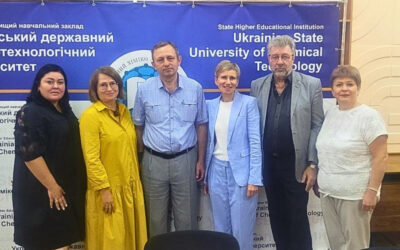
The Department of Computer-Integrated Technologies and Robotics Introduced Students of the “TANDEM” Lyceum to Robots, Measurements, and Computer Engineering
On October 9, 2026, representatives of the admissions committee of the SEI “Ukrainian State University of Chemical Technology” of USUST and lecturers from the Faculty of Computer Science and Engineering met with students of Dnipro Lyceum No. 123 “TANDEM” of the Dnipro...
USUCT SEI Postgraduate Student Viktor Makarchenko Researched Intelligent Modeling of Plasma-Chemical Processes
On September 11, 2026, a public defense of the dissertation of Viktor Serhiiovych Makarchenko, a postgraduate student of the Department of Information Systems of the SEI “Ukrainian State University of Chemical Technology”, took place at the Ukrainian State University...
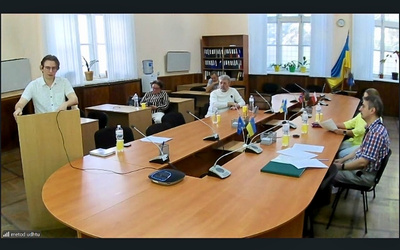
Postgraduate Student of the Department of Information Systems of the USUCT SEI Kyrylo Shapovalov Defended His Dissertation in Computer Science
On September 9, 2026, a public defense of the dissertation of Kyrylo Ihorovych Shapovalov, a postgraduate student of the Department of Information Systems of the Educational and Research Institute “Ukrainian State University of Chemical Technology”, took place at the...
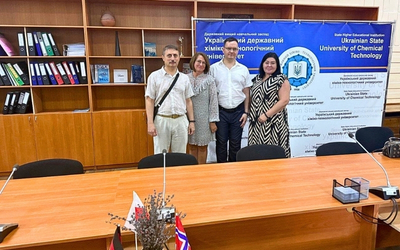
A postgraduate student of the Department of Information Systems of the USUCT SEI defended a dissertation in the specialty 122 Computer Science
On August 17, 2026, a public defense of the dissertation of Yurii Oleksiiovych Pertsev, a postgraduate student of the Department of Information Systems of the Educational and Research Institute “Ukrainian State University of Chemical Technology” (USUCT SEI), took...
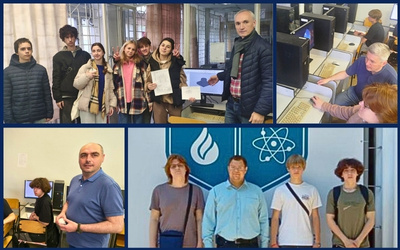
USUCT Educational and Scientific Institute Staff Contribute to an International Educational Project
Academic staff of the Educational and Scientific Institute "Ukrainian State University of Chemical Technology" of the Ukrainian State University of Science and Technologies (USUST) took part in the implementation of the international grant project "Enhancing the...
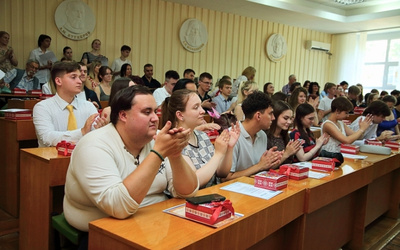
Winners of Research Competitions and Academic Olympiads Honoured at the Academic Council Meeting of the SEI USUCT
On 1 July 2026, during the meeting of the Academic Council of the Educational and Scientific Institute "Ukrainian State University of Chemical Technology" of the Ukrainian State University of Science and Technologies (USUST), a ceremonial award presentation was held...