
USUCT SEI Postgraduate Student Viktor Makarchenko Researched Intelligent Modeling of Plasma-Chemical Processes
The dissertation entitled “Intelligent Methods and Models of Computer-Mathematical Modeling of Plasma-Chemical Processes for Nanoparticle Production” was submitted for the degree of Doctor of Philosophy in the field of knowledge 12 “Information Technologies”, specialty 122 “Computer Science”. The scientific supervisor was Larysa Ivanivna Korotka, Candidate of Technical Sciences, Associate Professor of the Department of Information Systems of the SEI “Ukrainian State University of Chemical Technology” of USUST.
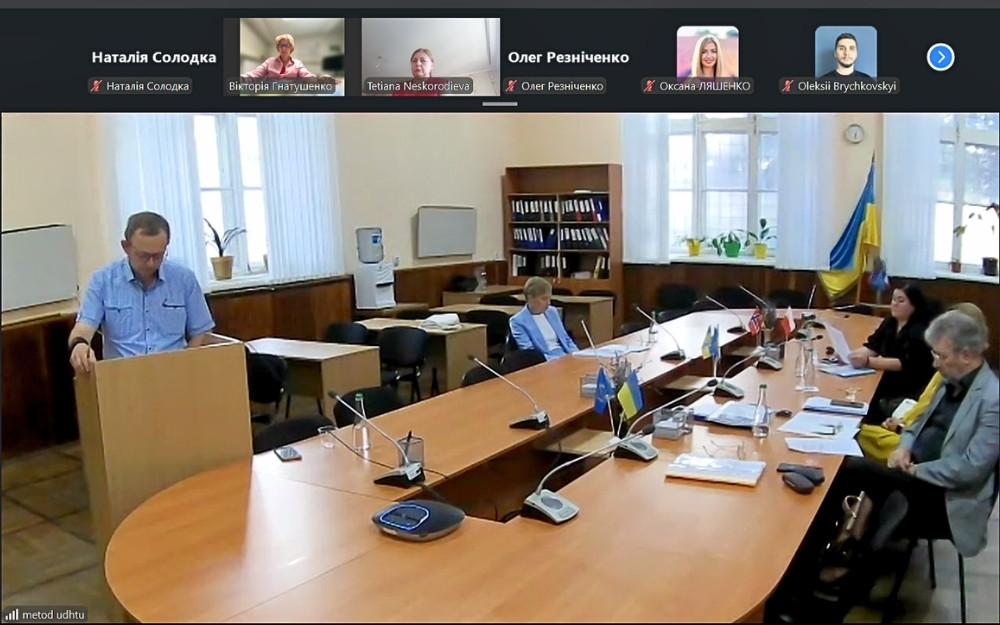
The following members joined the one-time specialized academic council:
- Chair of the one-time academic council — Dmytro Hehemonovych Zelentsov, Doctor of Technical Sciences, Professor of the Department of Information Systems of the SEI “Ukrainian State University of Chemical Technology” of USUST;
- Reviewer — Viktoriia Volodymyrivna Hnatushenko, Doctor of Technical Sciences, Professor, Head of the Department of Information Technologies and Systems of the SEI “Dnipro Metallurgical Institute” of USUST;
- Reviewer — Kateryna Yuriivna Ostrovska, Candidate of Technical Sciences, Associate Professor of the Department of Information Technologies and Systems of the SEI “Dnipro Metallurgical Institute” of USUST;
- Official opponent — Nataliia Anatoliivna Huk, Doctor of Physical and Mathematical Sciences, Professor, Acting Vice-Rector for Scientific and Pedagogical Work of Oles Honchar Dnipro National University;
- Official opponent — Tetiana Vasylivna Neskorodieva, Doctor of Technical Sciences, Professor of the Department of Information Technologies of Uman National University.
The research is devoted to computer-mathematical modeling of plasma-chemical processes for nanoparticle production under conditions of limited experimental data. Such processes are characterized by complex nonlinear relationships between parameters, therefore, modern machine learning and intelligent data processing methods are required for their analysis and modeling.
The work combines methods of statistical analysis, machine learning, generative adversarial networks (GANs), neural networks, and fuzzy logic. The quality of the models was assessed using, in particular, MAE, RMSE, MSE, and R² metrics. The research also included correlation analysis, mutual information assessment, feature importance determination, and the application of ensemble machine learning methods.
One of the key results was the improvement of the method for expanding small samples of experimental data using generative adversarial networks. Regularization and Mutual Information assessment mechanisms were added to the model, which made it possible to reduce the risk of “mode collapse” and preserve the relationships between input and output parameters.
For the first time, a hybrid approach to modeling the output parameters of a plasma-chemical process under conditions of limited data was proposed. It combines GANs for generating synthetic data, fuzzy logic for assessing their quality, and multilayer neural networks for determining the output parameters of a multidimensional non-stationary nonlinear process.
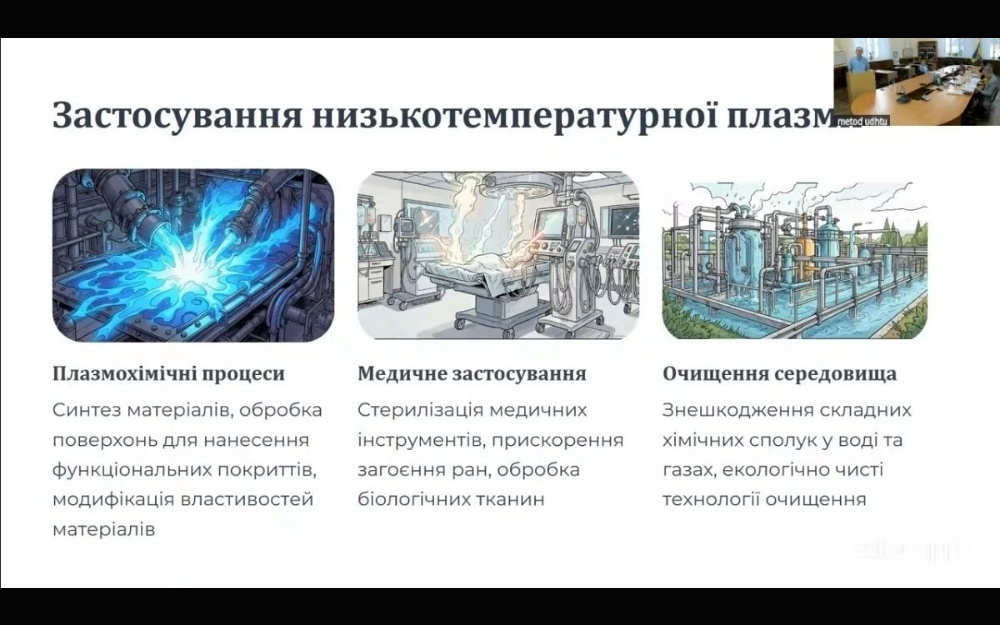
The practical significance of the results lies in the possibility of more effectively using small sets of experimental data for modeling plasma-chemical processes. The developed methods make it possible to expand the sample with synthetic data while preserving the physical meaning of the established relationships.
The study of experimental data on the synthesis of silver nanoparticles showed that nonlinear models provided accuracy within the range of 74–99%, whereas for linear models this indicator was 51–89%. Ensemble learning methods based on decision trees provided an accuracy of 87–94%. The obtained results confirmed the complex nonlinear nature of the relationships between the parameters of plasma-chemical processes.
The developed approach was also tested on new experimental data during the modeling of the gold nanoparticle synthesis process. The application of neuro-fuzzy filtering made it possible to reduce the overall error from 5% to 1.8%, and the relative error by 64% from the initial level.
Another practical result was the development of software tools for generating synthetic data and using them in computer modeling of plasma-chemical processes. The development was confirmed by Copyright Registration Certificate No. 1144970 for the computer program “Generation of Synthetic Data for Modeling Plasma-Chemical Processes for Nanoparticle System Production”, registered on April 1, 2026.
The research results were presented in scientific publications and materials of international scientific conferences. In particular, Viktor Makarchenko and Larysa Korotka had previously jointly studied the analysis and preparation of experimental data for modeling plasma-chemical processes for nanoparticle system production.
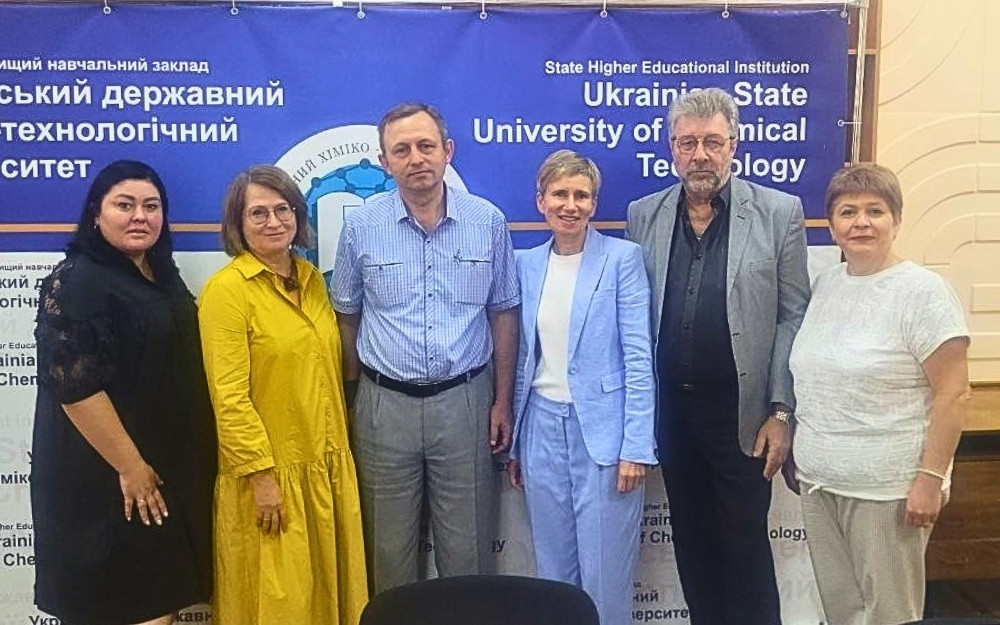
Following an open vote, all five members of the one-time specialized academic council unanimously supported awarding Viktor Serhiiovych Makarchenko the degree of Doctor of Philosophy.
We congratulate Viktor Serhiiovych and his scientific supervisor, Larysa Ivanivna, on the successful defense of the dissertation! We wish them new scientific results, research achievements, and professional development.
More details about the defense materials are available on the USUST website via the link