
Scientists of the SEI USUCT entered the World’s Top 2% Scientists 2025 ranking

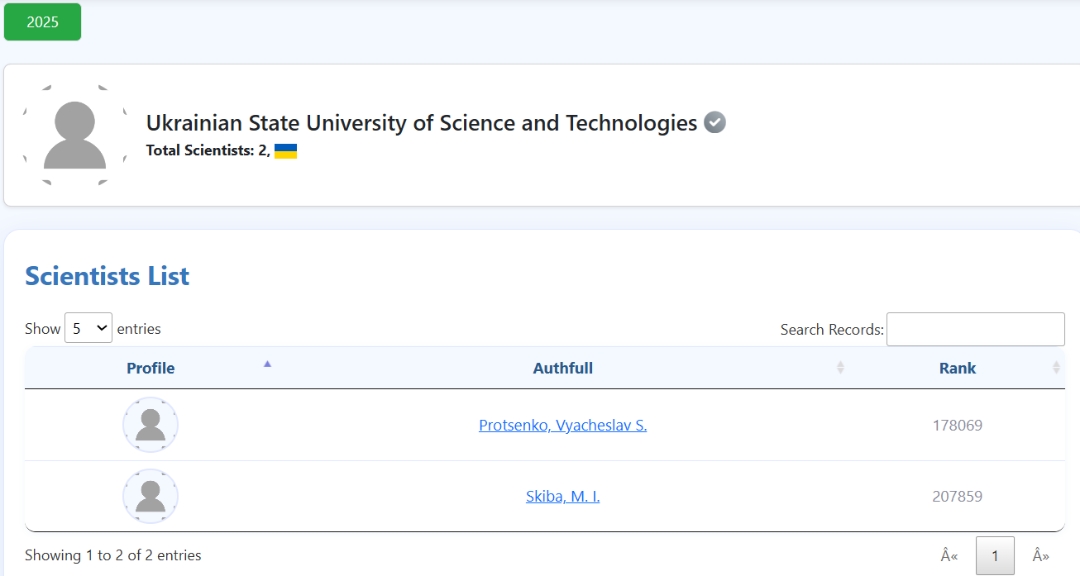
The updated international ranking of the World’s Top 2% Scientists for 2025, compiled by Stanford University in collaboration with Elsevier and ICSR Lab, includes two scientists from the Ukrainian State University of Chemical Technology:
- Protsenko Vyacheslav Sergiyovych, Doctor of Technical Sciences, Professor of the Department of Physical Chemistry, Director of the Research Institute of Galvanochemistry,
- Skyba Margarita Ivanivna, Doctor of Technical Sciences, Professor of the Department of Inorganic Materials Technology and Ecology.
This achievement testifies to the high scientific level, systematic publication activity and international recognition of the research of our colleagues.
Увійти до Top 2% – це не просто почесне звання:
- це свідчення того, що роботи науковця активно цитуються та впливають на розвиток галузі;
- це сильний аргумент під час конкурсів на гранти, академічних відзнак, міжнародної співпраці, підвищення статусу університету та інституту на глобальному рівні;
- для університету – це показник, що його науковий потенціал здатен конкурувати на світовій арені.
В 2025 році з України увійшло до рейтингу трохи більше ніж сто науковців, що робить присутність представників ННІ УДХТУ УДУНТ ще більш значимою.
Вітаємо колег із світовим визнанням та бажаємо подальших наукових успіхів!
What is the Top 2% Scientists ranking and how does it work?
The World’s Top 2% Scientists ranking identifies researchers with the most significant scientific impact, using data from the Scopus database, provided by Elsevier through the ICSR Lab.
Methodology for inclusion in the ranking:
- The basis is a composite indicator (c-score), which combines several important bibliometric metrics: total number of citations, h-index, index adjusted for co-authorship (Hm), as well as citations of works where the researcher was the only, first or last author.
- Scientists are classified by fields and subfields according to the Science-Metrix system (22 fields, over 170 subfields).
- The ranking includes those who belong to the top 2% of their subfield according to the c-score indicator, or are among the top 100,000 scientists in the global ranking (with or without self-citations).
- The indicators take into account both long-term contribution to science (all years of their career) and citations over the last year to maintain the relevance of the research activity.
This ranking is updated annually, which allows you to track the dynamics of the influence of scientists in the global scientific environment.
Also, additional information is available at link